
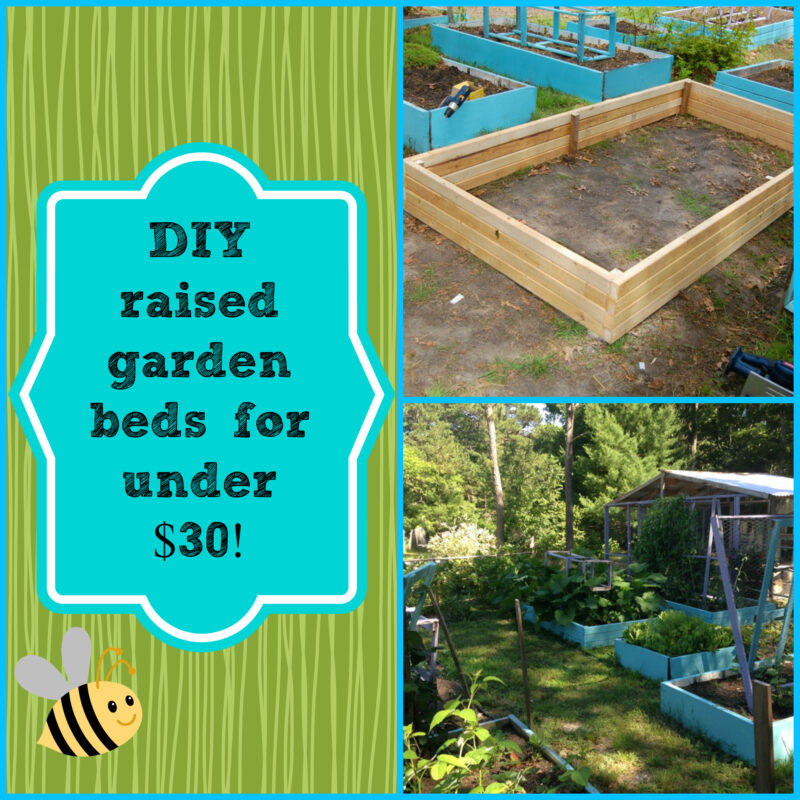
DIY Super Easy Raised Garden Bed for under $30
---------------------------------------------------------
Starting a raised bed garden can be an expensive prospect. You can buy a ready made kit, many of them topping out well over $100 per bed. I make my own raised beds, read on to see how you can make a raised garden bed for under $30! It’s easy and doesn’t require any special equipment aside from a screwdriver and a saw.
I have several size beds in my garden, but I have found that 4 ft x 8 ft is a great size, enough to handle lots of plants, even bigger ones like tomatoes, corn, & sunflowers. The bonus with a 4×8 bed is there is no waste when you use 8 foot boards.

I use untreated pine boards. If you have the budget for it, cedar is the best choice as it will resist rot & insects better than pine. But it’s also very pricey. Depending on your climate you should be able to get 7-8 seasons out of the pine before needing to replace them. You can use most any wood, metal, plastic, stone.
The only wood I avoid is pressure treated lumber. You should never used old (pre 2004) pressure treated wood or railroad ties you might have salvaged. Before 2004 residential pressure treated wood was treated with chromated copper arsenate. CCA was known to leach arsenic into the soil & plants growing in that soil. Currently, pressure treated wood is treated with a cooper based treatment. Experts say the health effects of using this for a raised bed are minimal. Excess cooper can stunt plant growth however. I say better safe than sorry and just choose a different material (or alternately line the pressure treated wood with plastic).
For this DIY article I will be using 2×3 pine boards, but you can see in my garden that some of my beds are made of stacked 2x4s, some are stacked 2x3s, some are 2x12s. I try to use what I can find or what is on sale at the lumber yard. You want the final bed to be 10-12 inches deep.
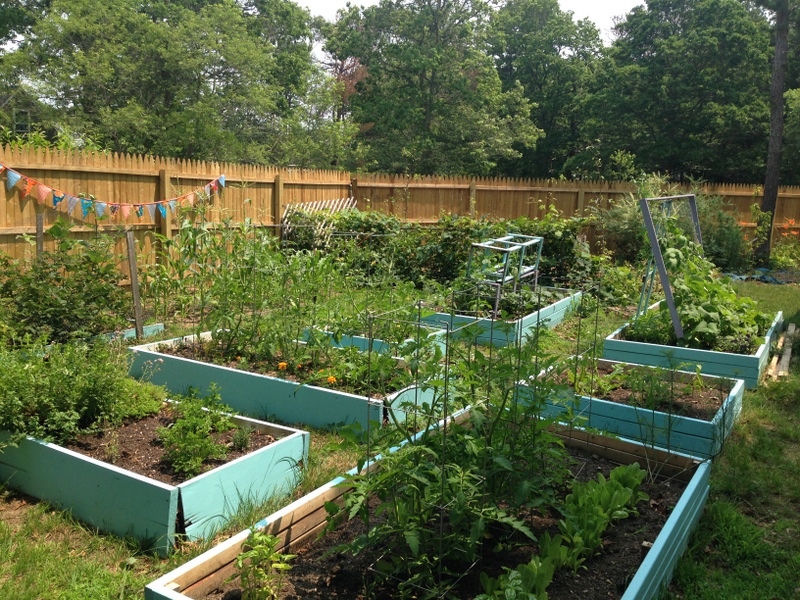
First prepare the area where your bed will be. You can put down a layer of weed cloth to keep weeds from popping up in your bed. You can also put down a layer of cardboard to smother weeds underneath. At the very least, remove any grass or growth and loosen the soil.
Materials:
12 pine boards 2 in x 3 in x 8 ft
2.5 inch or 3 inch screws (about 50)
scrap wood for supports (I used 2 in x 2 in boards)
paint (optional)
plastic sheeting, weed cloth (optional)
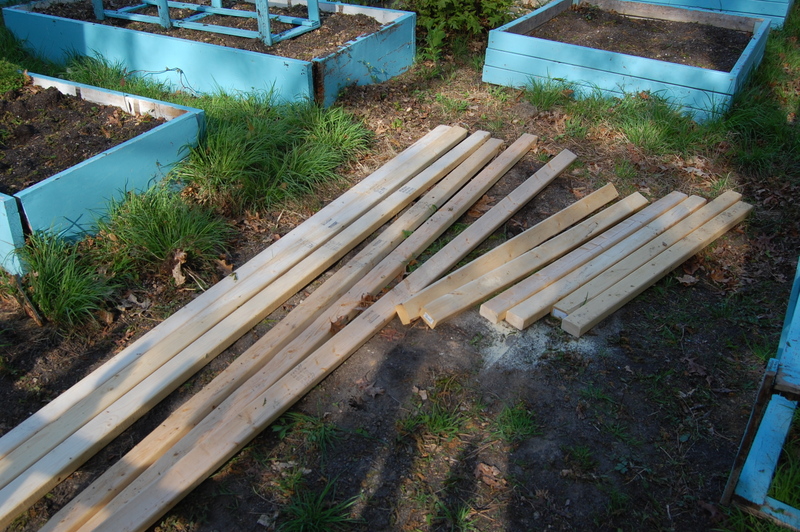
Separate 4 of the pine boards and cut them in half, so now you will have (8) 4 ft boards and (8) full size 8 ft boards
Put two screws in each corner to build a rectangle with two 8 ft boards and two 4 ft boards
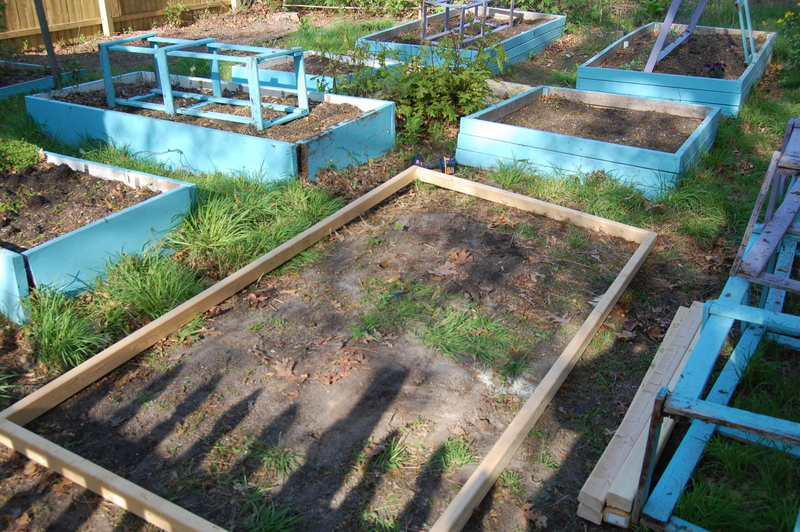
Make four of these rectangles
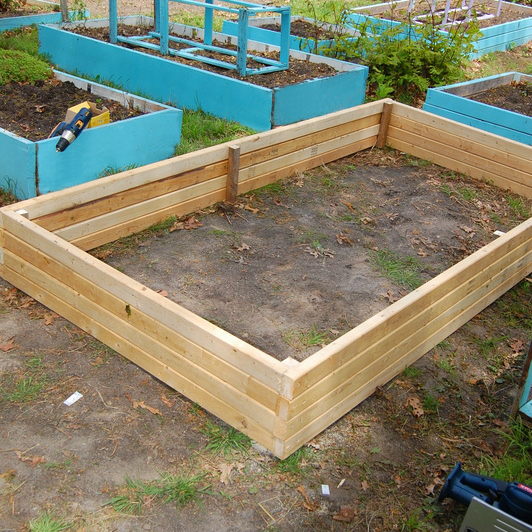
Stack the four rectangles where you want the garden bed to be, it’s ok if the boards are a bit warped and don’t line up fully.
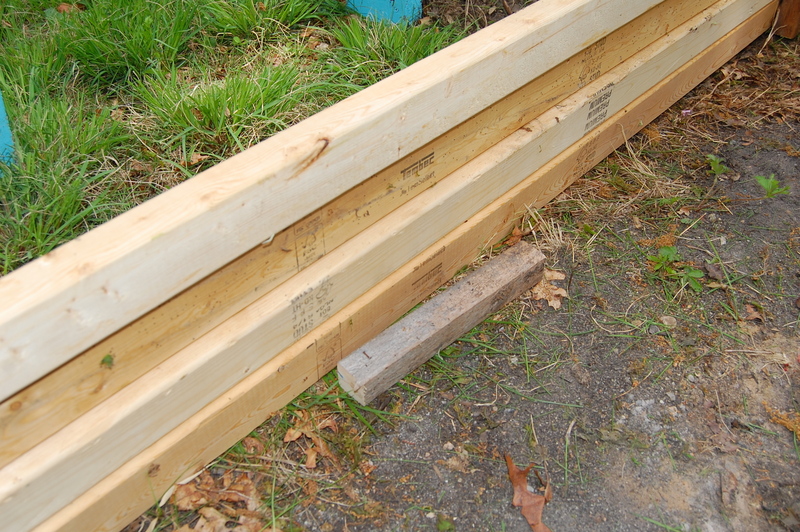
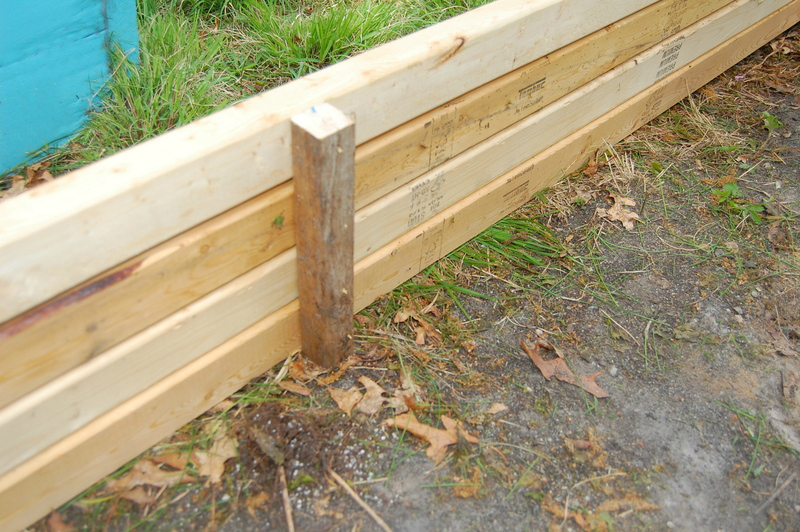
Use a scrap wood brace in each corner and in the middle of each 8 foot side (this will stabilize the bed and bring all the boards into alignment)
I like to paint my beds with a high quality outdoor paint. Don’t paint the inside to avoid any contamination. Not only does it look cute, it will help protect the wood for longer life. Another optional step to help prolong the life of your bed is to line the wood on the inside of the bed with plastic sheeting. This will provide a barrier between the wood & moisture.
Filling your raised bed
This can be where the real cost comes in. If you are resourceful it doesn’t have to be though. If you have a large compost pile this can help, but this bed will require about 27 cubic feet of soil (or 1 cubic yard) to fill so you would need a really big compost pile to fill this.
Check with your local municipality or farm extension. Many towns offer free or low cost compost to it’s residents, although you often have to be able to transport it yourself. Before bringing free compost to your garden, ask if it is screened. If not, it could contain seeds and weeds that will take over your garden.
Local farms or garden centers will usually offer good quality compost and often can deliver it right to your house for a fee.
I would not recommend relying solely on topsoil or loam to fill your beds as it won’t provide the nutrients your plants need. With intensive gardening styles like square foot gardening your plants will require a lot of nutrition so using cheap soil will hurt you in the end with poor plant growth. A 50/50 mix of compost & topsoil is a great all purpose blend for general vegetable garden styles & perennial beds. For square foot gardening it is recommended you add equal parts compost, vermiculite (to aid in nutrient absorption), and peat moss (to help with moisture retention).
Bagged soil at garden centers is generally going to be cost prohibitive to fill a bed this size. To buy good quality bagged compost it could easily cost you $140 or more to fill this bed, where you could get a yard of compost delivered and support a local farm for $25-$30.


I’m always looking for ways to cut costs, so appreciate your tips!
Love hearing your tips on raised beds, I am slowly transitioning to all raised beds, I love that I can sit on one while weeding in another! Thank you for sharing your post on Our Simple Homestead Blog Hop, as one of the co-hosts I will be featuring your post tomorrow!
– Nancy Nancy On The Home Front
Thank you! I also love being able to perch on the edge of my beds while weeding lol
Raised beds are a great solutions when you only have rock as we do for landscaping. I can plant almost anything in them. Congratulations on being featured on Nancy on The Home Front!
Stop by if you have a chance on the #OMHGFF this week!
Have a great week!
Karren
Thanks! I love my raised beds, it’s amazing the increase in yield I get!
These look great! We’ve had a heck of a time with our raised beds rotting. Wood just doesn’t last long in Florida. 🙁
Thanks for sharing on the Homestead Blog Hop. Your post was chosen as one of our Featured posts. Feel free to stop by and grab a Featured button to add to your post. http://www.notsomodern.com/homestead-blog-hop-67.html/
Hey Girl,
I am currently living in Florida but was born and raised on the cape. This is an excellent idea for building a garden! Thanks for the inspiration.
So excited to have found your blog and these tips!! I also saved your blog on the $5 trellis.
Thank you for sharing and now that I’ve found you, I look forward to following you here and on social media!
Thanks for joining us Stephanie! 🙂
Honestly, these are going to fall apart just like the blue ones did…..
Any bed made out of wood will eventually rot, but I have found that with the untreated pine I still get about 7 years out them
Why is it everything else I read on earth says pure compost is bad. Yet you are saying never use topsoil. Everything else on earth says to use 50% topsoil 50% compost.
On top of that your missinformation about treated lumber, please do your research before making educational articles. Your plants won’t uptake arsenic unless it is starving for potassium, you are using compost, this is not a problem.
In the 15 or so years I have been using raised beds I have never added topsoil to them, so i am sharing my experiences. Pure compost is not “bad”, and neither is mixing topsoil & compost. Topsoil is great for helping the soil hold its water and not dry out as fast which is why many people mix it with compost in their beds. Topsoil is also added because it is stronger so it won’t compact as quickly, leaving the bed less than full. I will clarify my statement, when I said “don’t use topsoil”, I meant don’t use it 100% to fill the bed. Your vegetables will not get the nutrients they need. I look at raised beds as really large pots. When you are growing a lot of plants in a pot or confined space (especially vegetables that use a lot of resources) they need a lot of nutrients. The garden section of my blog is aimed at people growing vegetables, and often in tight spaces which requires really rich soil. When gardening like this you will need to water more often because of the large amount of plants, and the depleted soil in the bed will need to be topped off each year. This works for annual vegetables as your new crop of plants each spring will have fresh rich soil. It would not work well if you are growing perennials whose roots would be disturbed by the shrinking soil in the bed. I realize not everyone reading my posts individually is familiar with my blog on a whole, so I will update the post to be more clear. Thank you for the feedback.
As for the treated lumber, I feel my post was already clear, that modern treated lumber is not treated with arsenic. I advised against using old, salvaged treated lumber because it is treated with arsenic and even though I am using compost and test my soil, not everyone will. Why would you want to risk that? My main issue with modern treated lumber is that it is treated with copper which can stunt or kill plants in excessive amounts. I admit in the article that pine boards are not a permanent solution. They will rot eventually, but they won’t kill your plants & are inexpensive
Good job Liz. And please ignore the morons that think treated lumber and toxic materials next to growing veggies are a good idea, it’s not a good idea and you are spot on with your choice to use inexpensive pine.
I’ve also seen people use cinder blocks and those are made from coal ash and industrial waste and are never a good idea (some claim the toxic stuff is all locked up in the concrete but concrete leaches in moisture and raised beds are moist). I also shy away from plastics because those leach as well.
Your pine beds are logical, non toxic, attractive, inexpensive, decent longevity for the buck, and a perfect project to tackle with my 5 year old son. Thank you.
Thanks Paul! It definitely is a great project to tackle with your son – good luck! 🙂
Its $35 for one 1×6×8 of untreated pine. We Cannot make a raised bed for $30 using that material.
You are absolutely right, I wrote this article in 2016. Lumber prices are outrageous right now! I will have to update