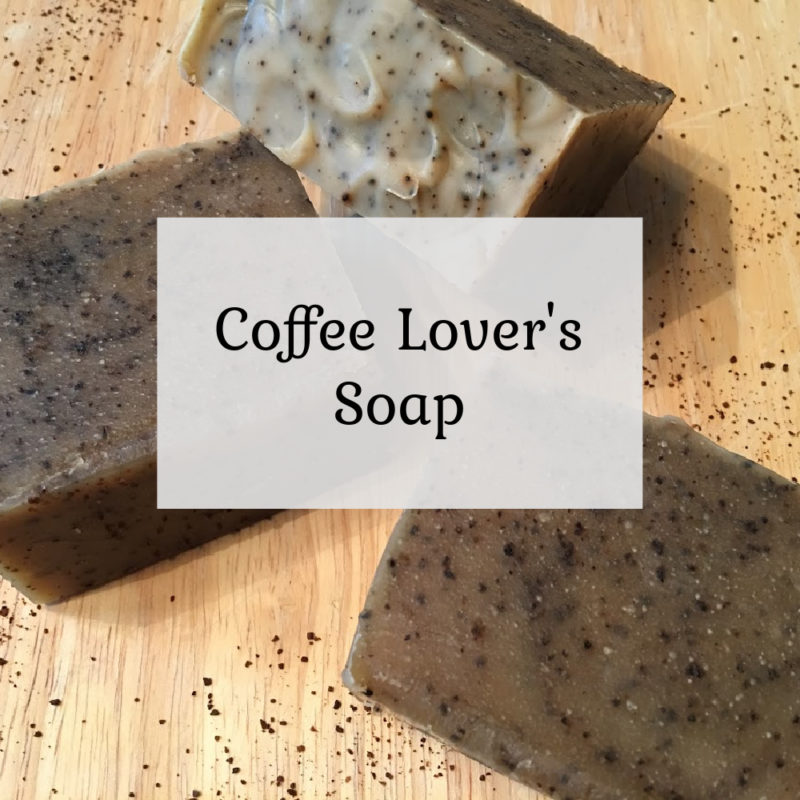
Coffee Lover’s Handmade Soap
---------------------------------------------------------
Do you LOVE coffee? Need that jolt of caffeine to get you moving in the morning? Did you know that your skin loves coffee too? Coffee is a great source of antioxidants. Washing with a coffee soap helps get those age-defying antioxidants into your skin to wash away toxins and cleanse your pores.
Caffeine might be a stimulant when you drink it, but on your skin, it has a soothing effect. It’s great for sensitive or sunburned skin. Caffeine constricts blood vessels, so it can help with the appearance of rosacea or redness. Caffeine has also been shown to possibly help with the appearance of cellulite by dehydrating underlying fat cells.
When you add coffee grounds to the soap it provides an excellent exfoliant to help sloth off dead skin layers, leaving your skin soft & younger looking. Coffee grounds also have a natural deodorizing effect so it’s a great soap to keep in the kitchen to wash cooking smells off your hands. Have I convinced you yet? Then let’s get started!

Before getting started, if you have never made soap before, check out my Basic Soap Making post. We will be working with lye, which can be very dangerous. Make sure you are taking proper safety precautions. Once the lye and oils have been saponified, no lye will remain in the soap and all that will be left are skin-loving oils & coffee.
This recipe will have 25 oz of oil with an 8% superfat. If you make any substitutions with the oils make sure you run the recipe through a soap calculator.
Ingredients:
9.5 oz brewed coffee (cooled to room temperature)
3.4 oz sodium hydroxide (lye)
6.25 oz Coconut Oil
6.25 oz Olive Oil
6.25 oz Palm Oil
3 oz Avocado Oil
2 oz Shea Butter
1.25 oz Castor Oil
2 TBSP ground coffee
Essential Oil or Fragrance Oil
Equipment (all equipment should only be used for soap making):
- 1 large & 1 medium bowl
- 1 bowl for an ice bath
- small bowls
- immersion blender
- gloves, eye protection & face mask
- digital thermometer
- spoons
- digital scale
- 10 inch silicone mold or other soap mold
Instructions:
Start by brewing your favorite coffee and allowing it to cool to room temperature. Do not add anything (like cream or sugar), just regular, black caffeinated coffee. As a lifelong New Englander of course I’m using coffee from Dunkin – Dunkin Donut’s Original Blend coffee
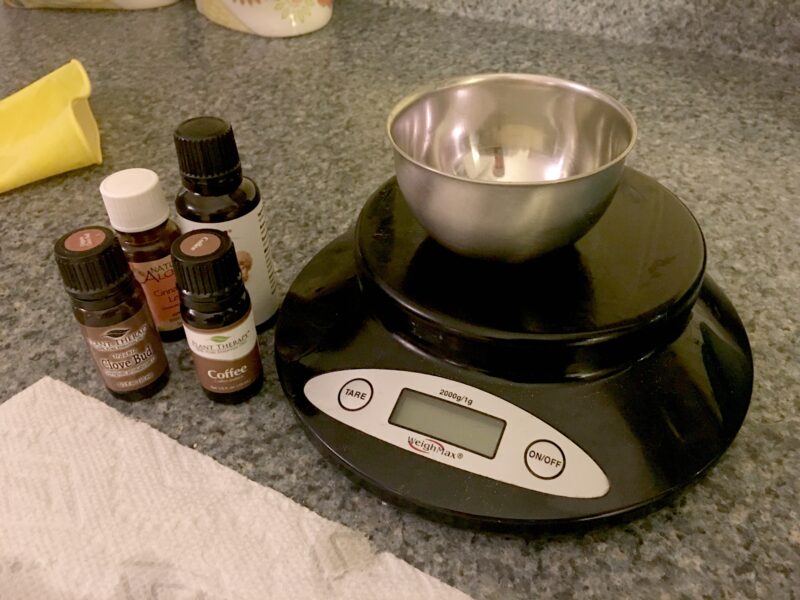
While your coffee is cooling, blend the essential oils together in a small bowl. The blend I used was 0.33 oz coffee, 0.20 oz cinnamon, 0.15 oz clove bud, & 0.15 oz nutmeg essential oils for a warm spicy coffee scent, but you can use whatever blend you like, or a coffee fragrance oil. Brambleberry has an Espresso fragrance oil that would be perfect.
Mix the lye into the cooled coffee
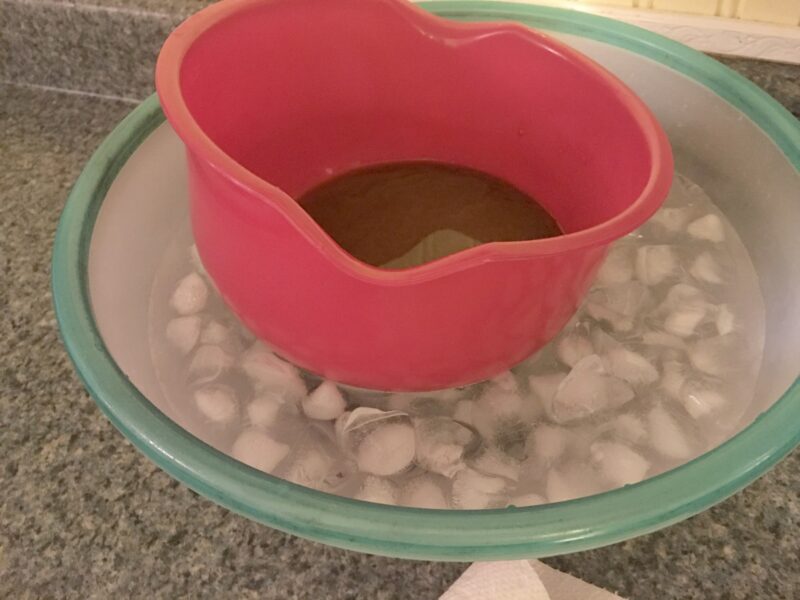
*Put on your safety gear!* Pour the cooled coffee into a medium bowl. Carefully measure the lye and slowly add it to the cooled coffee. Remember to use your safety equipment! Put the lye coffee bowl in an ice bath (a larger bowl filled with cold water & ice) and stir until the lye is totally dissolved. Alternatively, you can freeze the coffee in an ice cube tray ahead of time and add the lye to your coffee cubes.
When you add the lye, it will heat the coffee very quickly. The ice bath (or coffee cubes) will keep the temperatures down so you don’t end up with a burnt coffee smell in your finished soap. The lye coffee will likely smell pretty terrible, don’t worry. As long as you keep the temps down, the smell won’t transfer to the final product. Under 170 degrees is ideal, but the lower you can keep the temp the less smell there will be.
Measure & prep the oils
Measure out the Coconut, Olive, Palm, Shea, Avocado, & Castor oils into the large bowl. Microwave oils for 40 seconds, stir, then microwave for another 40 seconds. By now the oils should be all liquid (if they aren’t, put them back in for another 20-30 seconds). Alternately, use a double boiler to melt the oils on the stovetop. Set the oils aside to cool.
Let the lye & oils cool
Check the temperature of your lye coffee. If it’s 100 degrees or lower, you can take it out of the ice bath.
You want both the lye coffee & oils to be between 90-100 degrees before mixing them together. When soaping with food products, it’s best to soap with colder temperatures. While they are cooling, I like to put all my oils away, tidy up my workstation and get my soap mold ready to go.
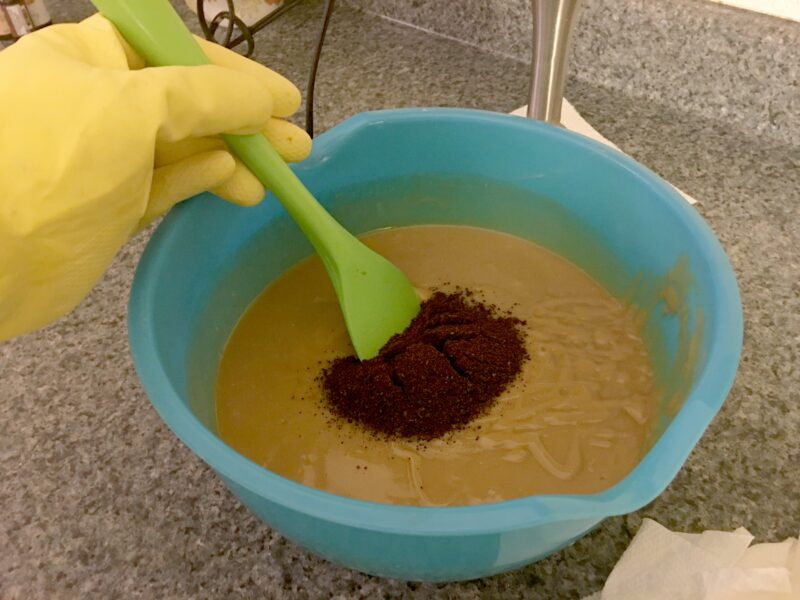
Once the lye coffee & oils are at the right temperature, put on your safety gear and slowly add the lye coffee to the oils. Using your immersion blender, blend until you reach a medium-thick trace. Add the essential oils and stir them in by hand. You want the soap mixture to be thick enough that it will suspend the ground coffee. Once you have the right consistency, add the ground coffee and stir in by hand.
Mold up your soap
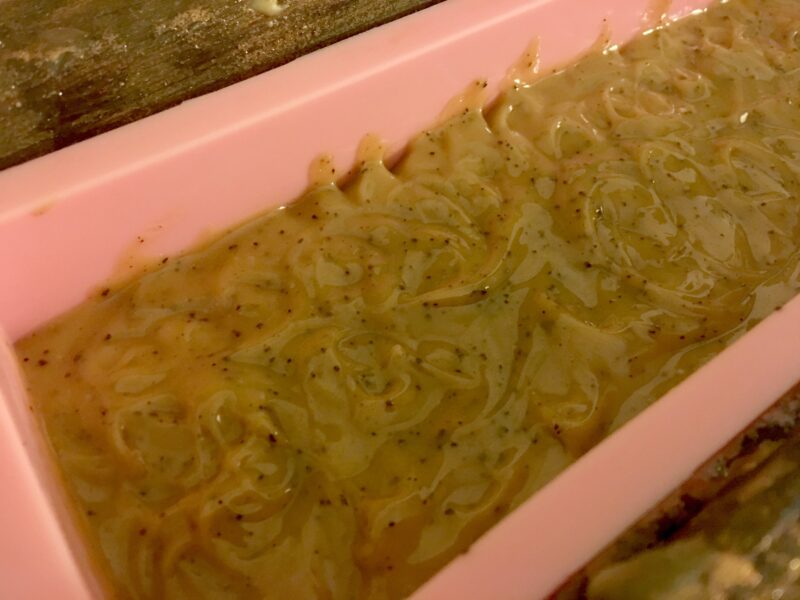
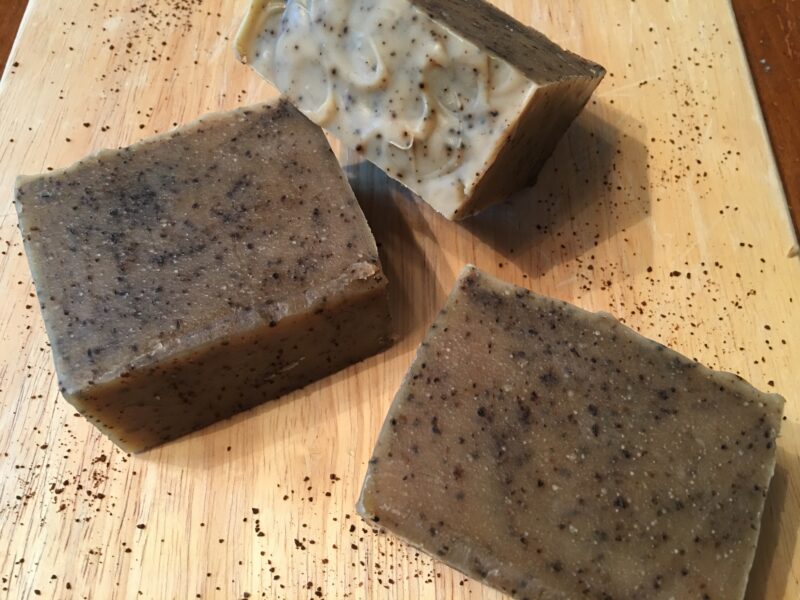
Pour the mixture into your soap mold. Tap gently against the counter to get rid of air bubbles. I used a toothpick to add a little bit of texture to the top. When I make soap with a food product I leave the soap mold uncovered and put it in the refrigerator overnight to prevent overheating. Coffee doesn’t have as much natural sugar as other food products I soap with (like goat or coconut milk, or honey), so refrigerating it might be overkill but I do it anyway. After about 24 hours, unmold your soap. Cut the bars and allow them to cure for 4-6 weeks.
Want to get the benefits of all-natural soap without having to purchase supplies and make it yourself? Check out my soap shop to buy some coffee soap without all the soap making hassle!

Thank you for sharing at Our Simple Homestead blog hop. Pinned your post. 🙂
Kathi at Oak Hill Homestead
Thank you for this great website. It really help a lot and please continue sharing this kind of blogs!
What a good job to think of posting this very informative and helpful data for us coffee lovers handmade soap
Thank you for the tips on the temperature for making coffee soap. I made mine at 120 degrees. Maybe too high . the soap cane out good .
I’ve done it both ways and the soap came out just fine either way. But keeping the temperatures cooler definitely makes for an easier soap making process 🙂
Hi, love your recipes and soap. Can I substitute Palm oil for another oil?
Yes you can *if* you recalculate the lye amount. Every oil has a different amount of lye needed to make saponification happen, so when you switch them out you need to run the new recipe through a soap calculator (this is the one I use: http://www.soapcalc.net/calc/soapcalcwp.asp). Palm oil is used in soap to increase the hardness and make it last longer in the shower, it also has cleansing properities. Other fats that are commonly used to replace Palm would be to use Lard or Babassu Oil. If you sub in 6.25 oz lard instead of the palm, you would change the lye to 3.35 oz. If you sub in Babassu oil, you would actually want to decrease the percentage of babassu and increase some of the other moisturizing fats (both because it’s expensive and because it would make the bar TOO hard and too drying). So a new palm free recipe with babassu would be – 9.5 oz water, 3.35 oz lye, 6.25 oz olive oil, 5 oz coconut oil, 5 oz avocado oil, 5 oz shea butter, 2.5 oz babassu oil, 1.25 oz castor oil. Hope this helps!
This recipe is GREAT! I gave some of my soap to my friends & family and they all told me how amazing it was! It’s PERFECT to fight against cellulite (no kidding, it worked wonders)! Thank you for this amazing recipe! I’ll be making another batch soon!
Yay! I’m so glad you all enjoyed it!
Are the measurements for your ingredients by volume or by weight? Also, how much soap does this make, 1 lb? 2 lb? Thank you.
The measurements are by weight, and it will make a 2.5 pound loaf of soap